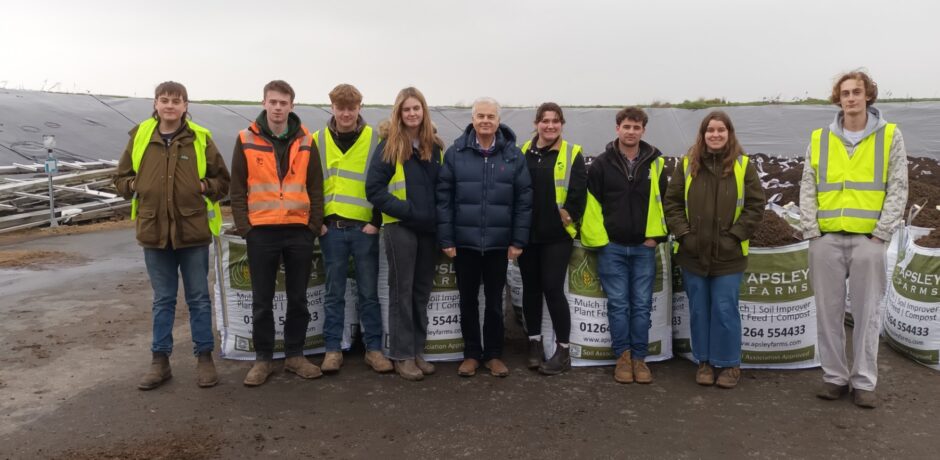
A number of our first-year Level 3 Crop Technician apprentices recently visited Apsley Farm in Andover to learn how a traditional farming business has evolved into a leading renewable energy producer.
The 1,150-acre family farm near Picket Piece operates one of the UK’s larger private anaerobic digestion plants, producing biomethane and electricity for the national grid, sustainable liquid CO2, soil improving mulch and dry ice, alongside its traditional farming operations. Our students visited the farm to learn how the business has diversified over time, combining conventional agriculture with innovative clean energy solutions.
The students were given a guided tour of the farm’s state-of-the-art biogas plant, where they were shown how arable crops grown both on the farm and by contracted farming partners are used in anaerobic digestion to produce renewable energy.
The tour covered the full process, from no-till farming techniques used to grow and process crops like maize, oats and rye, through to the production of biogas, which is upgraded and fed into the national gas grid, supplying enough gas to power around 10,000 homes.
According to the Department of Energy and Net Zero, the average UK home consumes 11,500kWh of gas per year, and the Apsley Farms plant produces 114 gigawatt hours of biomethane and generates a further 9.4GWh of renewable electricity. This has been achieved consistently over the last nine years.
The apprentices also explored the farm’s mulch and digestate processes, learning how by-products from energy generation are returned to the land to improve soil health and crop performance.
This circular approach demonstrates how sustainable crop production and clean energy can work hand in hand.
Apsley Farms’ Chairman Henry du Val de Beaulieu said:
“We were delighted to welcome the Sparsholt apprentices to the farm.
“Showing apprentices how renewable energy, soil health and crop production fit together is key to helping the next generation understand how modern farms can adapt to be both productive and environmentally responsible.”
Helen Dougherty, Curriculum Lead for Apprenticeships at Sparsholt College, said:
“Visits like these are invaluable for our students.
“Our students enjoyed finding out about sustainability in agriculture, and how Apsley Farms uses its by-products to create soil-improving mulch. Seeing these systems in operation help bridge the gap between theory and practice and highlight the exciting developments within our agricultural sector.”
Feeling Inspired? Explore Apprenticeship opportunities at Sparsholt College